
July 28, 2026 /
Since 2025, the weight-loss drug sector has entered a phase of rapid growth. The successive market approvals of Novo Nordisk’s oral semaglutide (Wegovy®) and Eli Lilly’s small-molecule orforglipron (Foundayo®) have marked a new era of oral administration for obesity treatment. The current pipeline of weight-loss therapeutics in development is highly diverse, spanning various molecular formats—such as peptides and small molecules—and targeting single-target GLP-1R, multi-target GLP-1R/GIPR/GCGR, as well as the amylin receptor (AMYR), among others.
For a weight-loss drug to successfully advance to clinical trials, selecting a suitable preclinical animal model is just as critical as optimizing its molecular structure and target design. Because drugs with different targets and molecular modalities possess distinct mechanisms of action, matching them with the appropriate animal model for efficacy studies is the only way to objectively and accurately predict their clinical efficacy in humans.
This article reviews major clinical-stage weight-loss pipelines worldwide and provides a stratified matching framework with standardized obesity animal models based on drug class, serving as a reference for selecting preclinical efficacy models in anti-obesity drug development.
I .Overview of Clinical-Stage Weight-Loss Drug Pipelines
Currently, several weight-loss candidates globally have advanced to Phase I, II, and III clinical trials. These drugs exhibit distinct differences in target profiles and molecular modalities, creating varying requirements for pathology and receptor compatibility in preclinical animal models.
Table 1. Some weight loss drugs in the clinical stage
| Drug | Company | Target | Modality | Development phase |
| MDR-001 | MindRank | GLP1R | Peptide | Phase Ⅲ |
| VK2735 | Viking Therapeutics | GLP1R, GIPR | Peptide | Phase Ⅲ |
| Zenagamtide | Novo Nordisk | GLP1R, DACRA | Peptide | Phase Ⅲ |
| Cagrilintide | Novo Nordisk | DACRA | Peptide | Phase Ⅲ |
| Eloralintide | Eli Lilly | SARA | Peptide | Phase Ⅲ |
| HRS-7535 | Kailera, Hengrui | GLP1R | Small molecule | Phase Ⅲ |
| Elecoglipron | AstraZeneca | GLP1R | Small molecule | Phase Ⅱ |
| CT-996 | Roche | GLP1R | Small molecule | Phase Ⅱ |
| HDM-1002 | Huadong | GLP1R | Small molecule | Phase Ⅱ |
| Monlunabant | Novo Nordisk | CB1R | Small molecule | Phase Ⅱ |
| PF-07976016 | Pfizer | GIPR antagonist | Small molecule | Phase Ⅱ |
| Petrelintide | Roche, Zealand Pharma | DACRA | Peptide | Phase Ⅱ |
| AZD6234 | AstraZeneca | SARA | Peptide | Phase Ⅱ |
| IBI-3032 | Innovent | GLP1R | Small molecule | Phase Ⅰ |
| MK-4082 | Merck | GLP1R | Small molecule | Phase Ⅰ |
| ACCG-2671 | Structure Therapeutics | DACRA | Small molecule | Phase Ⅰ |
| GUBamy | AbbVie, Gubra | DACRA | Peptide | Phase Ⅰ |
| NNCO174-1213 | Novo Nordisk | SARA | Peptide | Phase Ⅰ |
DARCA: dual amylin and calcitonin receptor agonist. SARA: selective amylin receptor agonist.
II. Four Obesity Animal Models to Match Weight-Loss Drug R&D Needs
For drugs with distinct targets and molecular modalities, selecting the appropriate animal model during the preclinical phase is essential for accurately assessing therapeutic efficacy.
- Wild-Type Diet-Induced Obesity (DIO) Mouse: The Gold Standard for GLP-1R/GIPR/GCGR Peptide Drugs
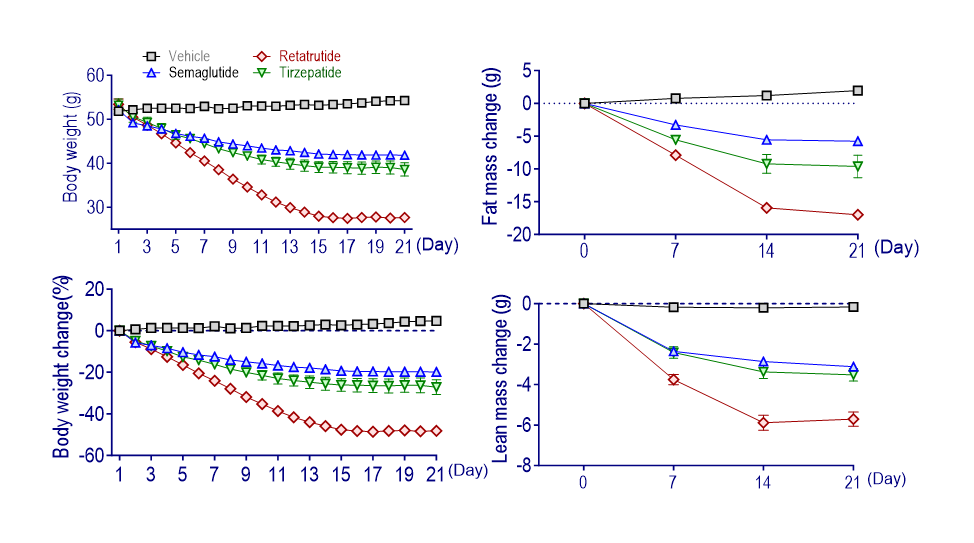
For peptide-based weight-loss drugs targeting GLP-1R, GIPR, and GCGR, the high-fat diet-induced wild-type (DIO) mouse model represents the “gold standard” for preclinical efficacy evaluation. This model offers several key advantages, including low induction costs, short experimental cycles, high data stability, and excellent reproducibility. As shown in Figure 1, the weight-loss effects of semaglutide (GLP-1R), tirzepatide (GLP-1R/GIPR), and retatrutide (GLP-1R/GIPR/GCGR) can be clearly evaluated in this model, yielding consistent and reliable results.
- Humanized DIO Mouse Models: Dedicated Evaluation Platforms for Human-Targeted Small-Molecule Drugs (e.g., GLP-1R, GIPR)
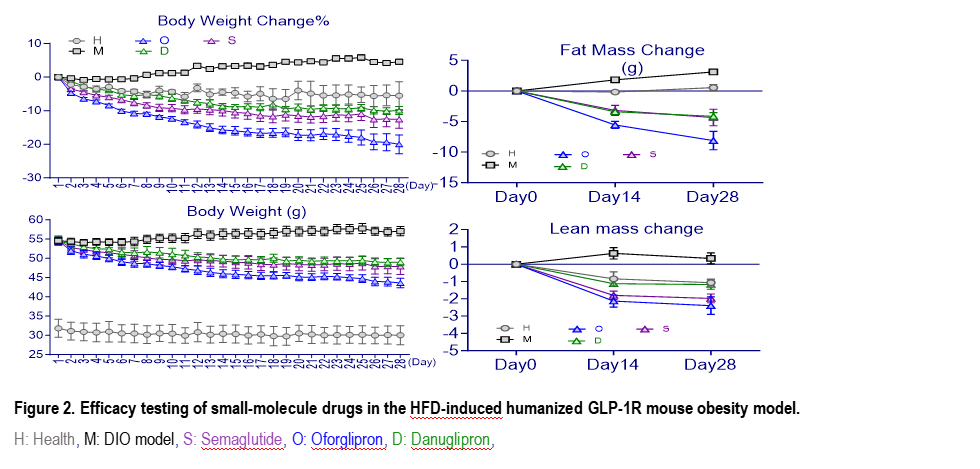
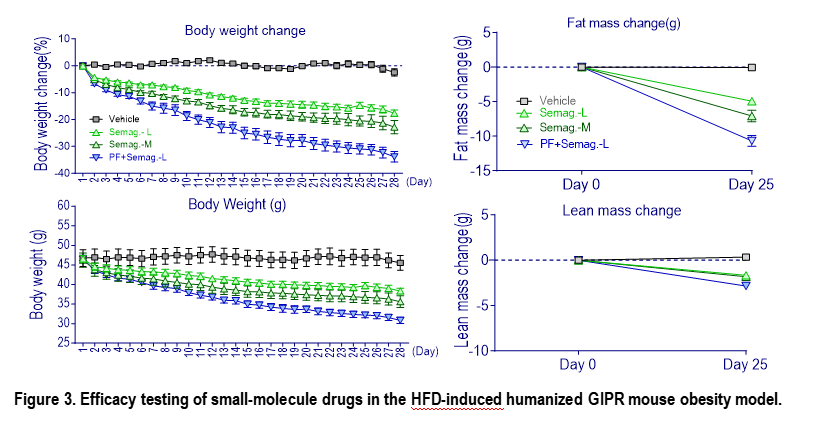
Small-molecule agonists and antagonists targeting human metabolic receptors often display extremely low affinity for native mouse orthologs. Consequently, wild-type mice fail to accurately capture their in vivo efficacy, necessitating humanized models (e.g., hGLP1R, hGIPR).
As shown in Figures 2 and 3, the efficacy of Orforglipron (a small-molecule GLP-1R agonist) and PF-07976016 (a small-molecule GIPR antagonist) was successfully validated using high-fat diet (HFD)-induced hGLP1R and hGIPR humanized DIO mouse models, respectively.
- High-Fat Diet (HFD)-Induced DIO Rat Model: The Preferred Evaluation Platform for Amylin-Pathway Drugs (DACRA/SARA)
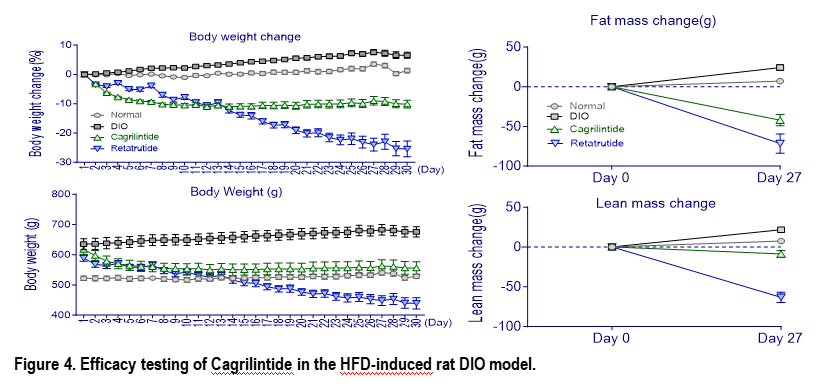
For therapeutics targeting the amylin pathway, such as dual amylin and calcitonin receptor agonists (DACRAs) and selective amylin receptor agonists (SARAs), the high-fat diet-induced (DIO) rat model is the preferred system for in vivo evaluation. The metabolic and endocrine signaling networks in rats align closely with the mechanism of action of amylin-class drugs, effectively capturing their two key clinical benefits: fat-selective weight loss with lean mass retention, and enhanced insulin sensitivity.
As shown in Figure 4, the long-acting amylin analog Cagrilintide drives selective fat loss while preserving muscle mass in this model. These results closely mirror clinical outcomes, underscoring the strong translational relevance of the DIO rat model for metabolic drug discovery.
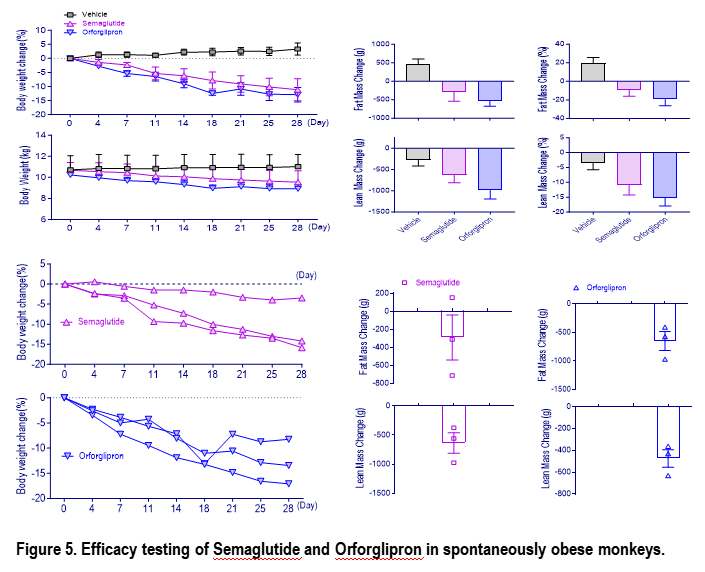
- Non-Human Primate (NHP) Obesity Models: The Gold Standard for Translational Validation
When rodent models present translational barriers—such as evaluating nucleic acid therapeutics or novel multi-target combination therapies—or when performing head-to-head comparisons of candidate efficacy and long-term safety, non-human primate (NHP) obesity models serve as the definitive pre-clinical platform.
Due to their high genetic, metabolic, and endocrine homology with humans, NHPs provide unmatched accuracy in assessing weight-loss magnitude, individual responder variability, and long-term metabolic profiles. This significantly bridges the gap between preclinical findings and human clinical outcomes, drastically reducing translational risk. As shown in Figure 5, efficacy testing of Semaglutide and Orforglipron in a spontaneously obese NHP model demonstrated robust clinical concordance across both cohort-level data and individual response trajectories.
III. Pharmalegacy Metabolism & Endocrinology Platform: End-to-End Preclinical Efficacy Services for Anti-Obesity Therapeutics
Backed by deep domain expertise and extensive hands-on experience in metabolic disease research, Pharmalegacy offers comprehensive, one-stop preclinical evaluation services to accelerate your anti-obesity R&D pipeline.
Study-Ready Disease Models:
- High-Fat Diet (HFD) DIO Rodent Models: Ready-to-use wild-type and humanized mouse and rat models.
- Obese Non-Human Primate (NHP) Models: Spontaneous and induced cynomolgus monkey obesity platforms.
Comprehensive Pharmacodynamic & Mechanism of Action (MoA) Capabilities:
- Body composition analysis
- Continuous food intake monitoring and metabolic profiling
- Comprehensive biomarker assays
- Advanced tissue histology (adipose, skeletal muscle, liver, etc. )
- Deep transcriptomic profiling via RNA-Seq for in-depth mechanistic insights