
EXPERTLY EXECUTED PRECLINICAL ALS STUDIES
PharmaLegacy has the models and experience to drive your ALS pipeline forward.
PHARMALEGACY HAS THE EXPERTISE AND MODELS YOU NEED TO ADVANCE YOUR ALS PROGRAM.

MODELS / SERVICES
Case Study - SOD1-G93A transgenic model of ALS in mouse and rat & Endpoint Measurements
Amyotrophic lateral sclerosis (ALS) is an adult-onset neurodegenerative disease characterized by rapid disease progression. Its primary pathological hallmark is the degeneration and death of both upper motor neurons (UMNs) and lower motor neurons (LMNs). UMNs connect the brain to the spinal cord, while LMNs link spinal UMNs to peripheral skeletal muscles.
Motor neurons regulate voluntary muscle contraction and dominate vital physiological functions, including movement, swallowing, vocalization and respiration. The progressive degeneration of UMNs and LMNs leads to gradual paralysis of the innervated muscles. Progressive deterioration of motor neurons in ALS blocks neural signal transmission, impairing the brain’s ability to initiate and control muscle movement. This further results in muscle atrophy and paralysis. In the terminal stage of ALS, diaphragmatic atrophy and paralysis occur, and patients eventually die of respiratory failure.
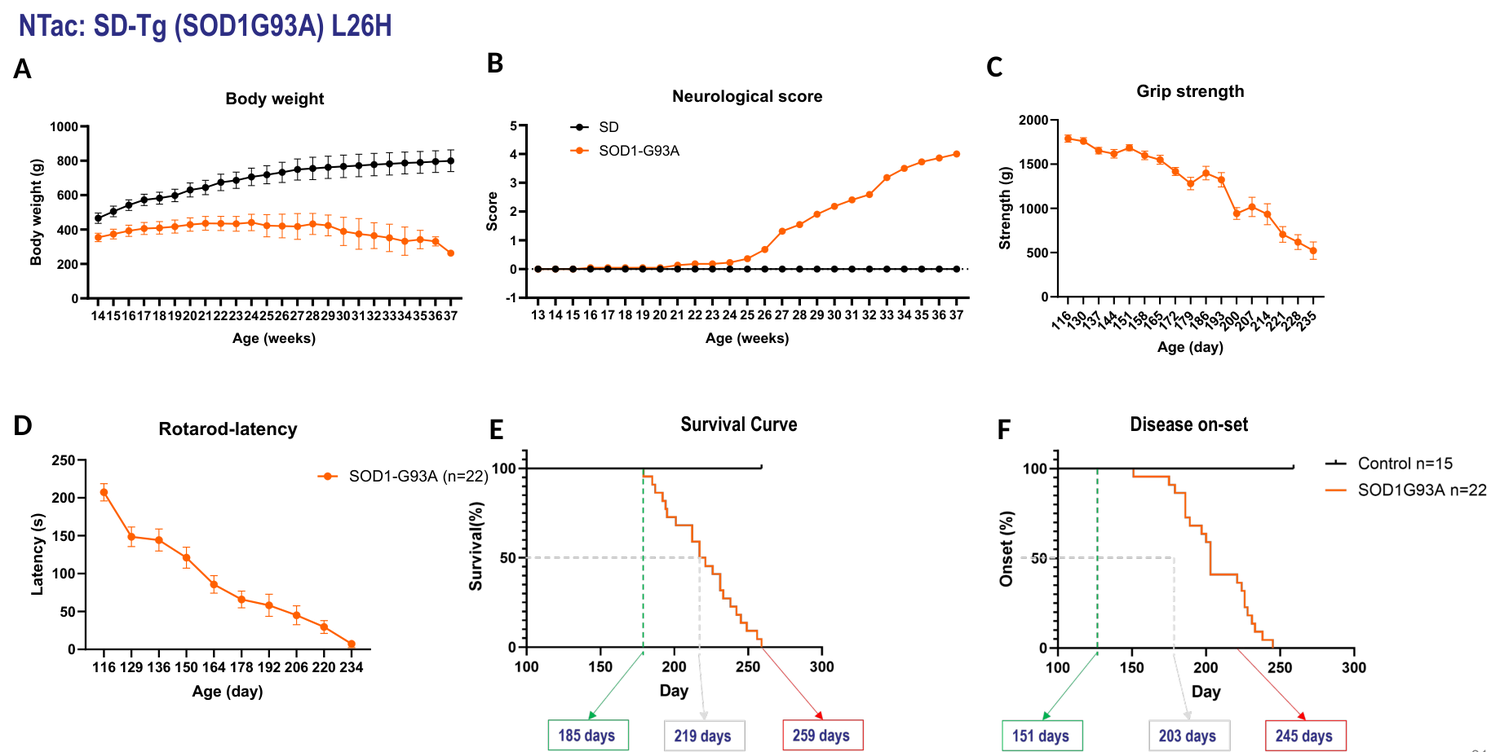
PharmaLegacy has adopted the most commonly used SOD1-G93A rat model for ALS model validation. A series of indicators were evaluated in this model, including body weight change, neurological score, grip strength, rotarod performance, survival curve and CMAP.
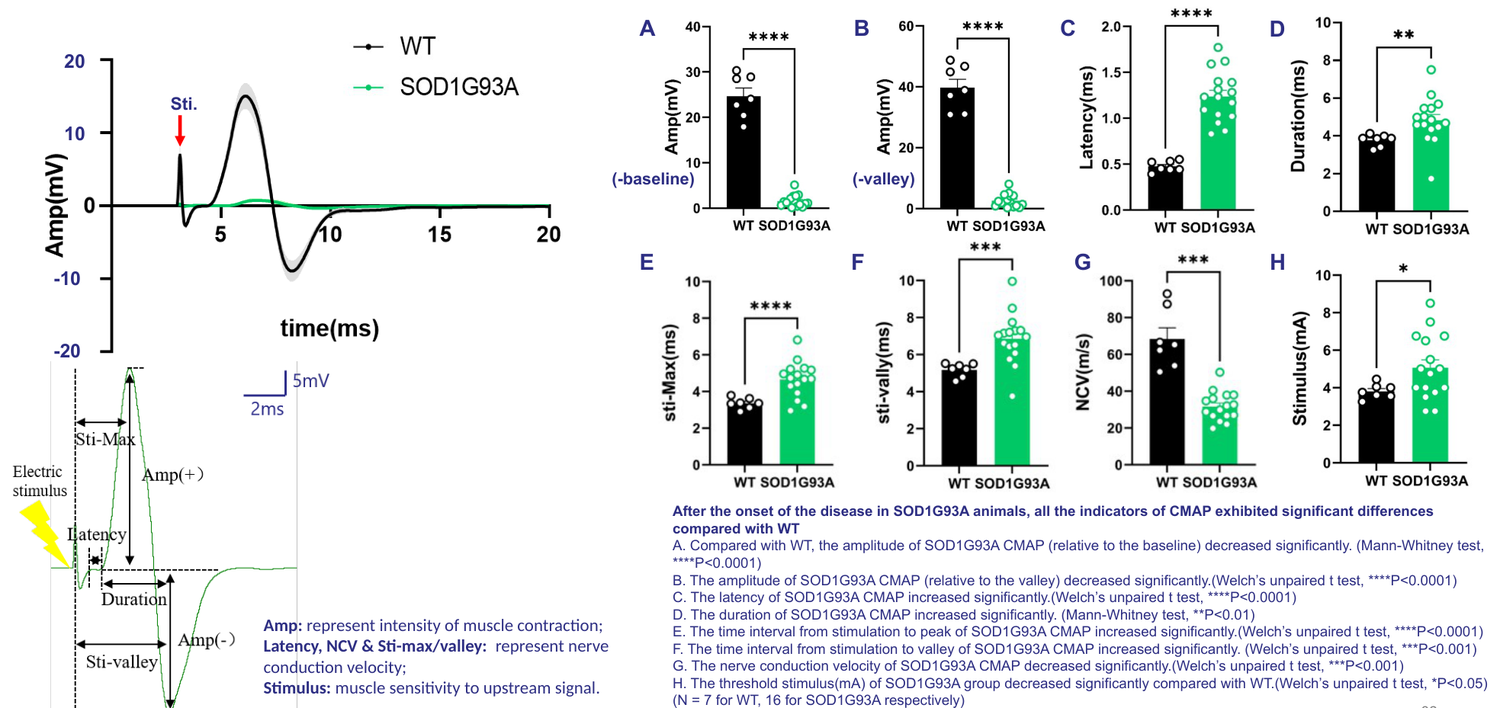
SOD1-G93A rats showed distinct changes in body weight and neurological scores relative to healthy SD rats. Both grip strength and rotarod falling latency declined progressively with aging in SOD1-G93A rats. Survival analysis demonstrated that the median survival time of SOD1-G93A rats was 219 days, with the earliest death recorded at 185 days and the latest death at 259 days. Disease onset was defined as a neurological score reaching 2 points, and the corresponding median disease onset time of SOD1-G93A rats was 203 days, with the earliest onset time of 151 days and the latest onset time of 245 days. After disease onset, all compound muscle action potential (CMAP) indicators of SOD1-G93A rats were significantly different from those of wild-type (WT) rats. Specifically, SOD1-G93A rats had a significant reduction in CMAP amplitude relative to the baseline (****P<0.0001) and a remarkable decrease in CMAP amplitude relative to the valley (****P<0.0001). These model rats also presented significantly prolonged CMAP latency (****P<0.0001) and CMAP duration (**P<0.01). Besides, the time intervals from stimulation to peak and from stimulation to valley were both markedly increased (****P<0.0001 and ***P<0.001, respectively). Additionally, SOD1-G93A rats exhibited decreased nerve conduction velocity and lower threshold stimulus (mA) compared with WT rats (***P<0.001 and *P<0.05, respectively). The sample size was 7 for the WT group and 16 for the SOD1-G93A group.
Survival Curve & Disease Onset
Compound Muscle Action Potential (CMAP) Analysis
PharmaLegacy’s operational advantages:
- 1500+ validated animal models of disease spanning 100+ indications
- 30,000+ animal capacity
- Staffing and facilities to run 200+ concurrent studies
- 380,000 square feet of facilities
- Ability to start most studies in under 2 weeks
Advance your ALS pipelines with certainty and speed. Contact PharmaLegacy today.
We’re ready when you are.
Tell us your ALS pipeline challenges.


